
Stop guessing: how to track what your direct mail actually does online
You already know direct mail works — the response rates and the calls it generates tell you that much. What most Boca Raton businesses can’t answer is the next question: what happens after someone opens the envelope? Did they visit your site? Did they call? Did they just toss it? Without a way to connect the physical piece to what happens online, you’re spending real budget on a channel you can only half-measure.
The blind spot most print campaigns run into
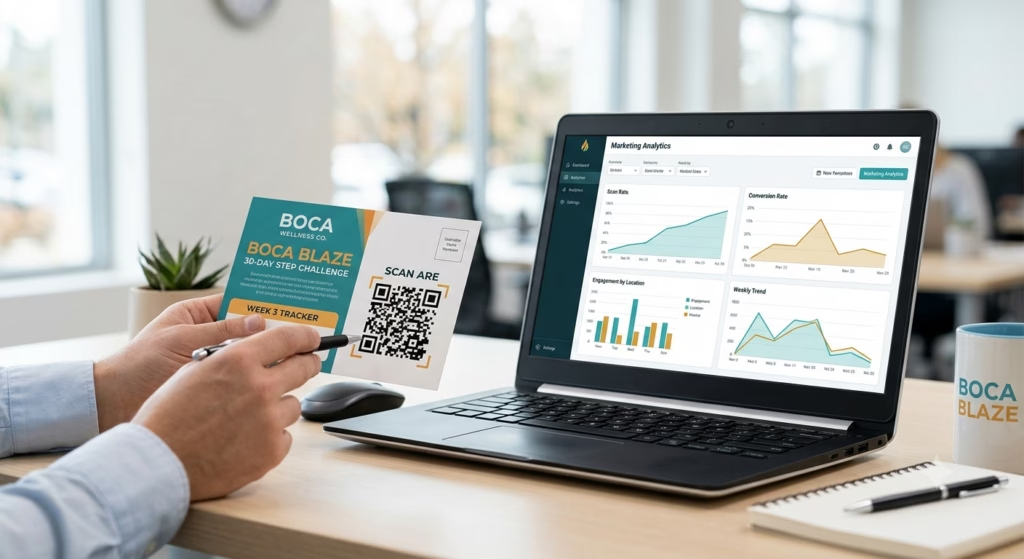
Digital marketing gets measured by default — every click, every impression, every conversion is logged somewhere. Direct mail doesn’t come with that built in. A postcard goes out, and unless you’ve built a bridge back to something trackable, the story ends there. That gap makes it nearly impossible to tell a genuinely underperforming mailer from one that’s actually working but getting no credit for it.
The fix isn’t complicated, but it does have to be built into the campaign from the start — not bolted on after the fact. Once a mail piece has a trackable path back to a digital action, you’re no longer guessing at what a campaign did. You’re reading it off a dashboard.
How do you track the ROI of a direct mail campaign?
You track direct mail ROI by giving each mailer its own trackable path back to a digital action — a unique QR code, a personalized URL, a dedicated landing page, or a call-tracking number — so every response can be tied directly to that specific campaign. None of these tools work in isolation especially well; the strongest setups usually combine two or three, so a recipient scanning a QR code and later calling a tracked number both get logged as the same touchpoint. The result is a report that shows exactly which piece, which list, and which offer drove the response — not just an overall guess at what mail “probably” did.
The four tools that make direct mail measurable
Custom QR codes — a scannable code printed on the mailer that logs exactly who engaged and when. A Boca Raton restaurant running a menu mailer, for example, can send a scan straight to an online reservation form instead of a generic homepage, so the scan and the booking are connected in one step.
Personalized URLs (PURLs) — a unique web address assigned to each recipient. When that specific URL gets visited, you know exactly who showed up, which makes tailored follow-up possible instead of a blanket email blast. A real estate firm in Palm Beach County sending property brochures can use PURLs to see precisely which prospects came back for more information.
Dedicated landing pages — a page built specifically for mail traffic, with a message and form matched to that campaign rather than your general website. Because the page exists only for that mailer, every visit and conversion on it can be attributed cleanly.
Call tracking numbers — a dedicated phone number printed on the mailer that routes normally but logs the source. Service businesses in particular lean on this one, since a phone call is often the actual conversion event, not a form fill.
What this looks like once the data starts coming in
A local event organizer in Boca Raton mailing invitations can see, neighborhood by neighborhood, which zip codes actually responded — information that shapes the next mailing list before a dollar gets spent on it. Once you’re seeing which offers, which messages, and which lists actually convert, direct mail stops being a channel you fund on faith and starts being one you optimize the same way you would a paid search campaign.
Getting it set up with Minutemarketing.ai
We build the tracking infrastructure into your direct mail campaign from the planning stage — matching QR codes, PURLs, landing pages, and call tracking numbers to your specific goals, then pulling all of it into one dashboard alongside your existing digital marketing data. That means your direct mail spend finally shows up next to your SEO, PPC, and Google Business Profile numbers, instead of sitting in a separate, unmeasured bucket.
Ready to see your direct mail’s real ROI? Call 833-408-1630 or 561-645-8190 to get started.